
Commercial Transformation

Not only smart

Experience-first customer operations, smart and deeply human

But also deeply human.

Transform how you engage customers – from first contact to lasting loyalty

Customer engagement often falls short. Sales and marketing aren’t aligned. Service feels disconnected. We help you transform the entire commercial operation. From how you attract and convert customers to how you serve and retain them.

Consider Commercial Transformation when …

You struggle with fragmented customer engagement between Marketing, Sales and Service

  • Inconsistent customer experience at different touchpoints
  • Leading to wasted effort and misaligned messaging.
  • There is no shared definition of who your ideal customer actually is
  • Siloed departments, working in their own bubble
  • Each department optimizes for their own KPIs
Types of commercial transformation We devcelop

Two Paths to Transform Your Commercial Operations

Depending on your challenge, we focus on commercial excellence or customer operations.

Commercial Excellence Program

Align sales and marketing around your Ideal Customer Profile for maximum impact.

What you get

• Shared ICP that everyone targets
Aligned messaging across touchpoints
• Higher conversion rates
• Shorter sales cycles
Better lead quality
• Teams that actually work together

Experience-first Customer operations

Not only smart but also deeply human. Turning satisfaction into loyalty and business value.

What you get

• Service model that scales
• 70% automation for routine tasks
• Empowered teams for complex issues
• Higher customer satisfaction
• Lower cost-to-serve
• Service that builds loyalty

Commercial Excellence: proven approach to align sales and marketing

Your Biggest Untapped Opportunity

Your biggest untapped opportunity isn’t a new market or product. It’s getting sales and marketing to work as a single, aligned force. When they target the same customer, deliver the same message, and optimize for the same outcomes, everything changes. Conversion rates climb. Sales cycles shorten. Customer quality improves.

Most companies have talented sales and marketing people. The problem isn’t the people. It’s the lack of alignment. Different targets, different messages, different metrics. We bring them together around what matters: your Ideal Customer and their missions.

But alignment doesn’t happen by accident. It requires a shared foundation: a crystal-clear Ideal Customer Profile built on real data, not assumptions. It demands understanding what customers are actually trying to achieve. Their missions, not just their demographics. And it needs engagement strategies designed around how ideal customers actually buy.

That’s what Commercial Excellence delivers. We work with your teams to define who you should be targeting, understand what drives them, and design how you’ll engage them at every stage. The result? Sales and marketing operating as one commercial engine, driving predictable, scalable growth.

Discover our open, proven way of working

Achieving commercial excellence takes more than good intentions. It requires a proven framework that transforms competing priorities into shared purpose. That’s where our 5D methodology comes in. Through Define, Discover, Design, and Deploy & Deliver, we work alongside your teams to build alignment from the ground up. The process is transparent, collaborative, and designed to turn insight into action.

Most companies have talented sales and marketing people. The problem isn’t the people – it’s the lack of alignment. Different targets, different messages, different metrics. We bring them together around what matters: your Ideal Customer and their missions.

  • Customer Analysis. Analyze your best customers to identify patterns
  • ICP Workshop Co-create ICP with sales and marketing teams
  • Decision Making Unit, Map who’s involved in buying decisions

What are your customers trying to achieve? What’s blocking them? We dig deep to understand their real motivations, not just surface-level needs.

  • Customer Interviews: Talk to real customers about their goals
  • Mission Mapping. Identify the jobs customers expect you to do
  • Journey Analysis. Map how customers currently engage with you
  • Creating Mission Canvasses that outline customer missions, the resources needed, and the teams required to accomplish those missions. Identify gaps, and align teams with the new Mission Canvasses.

With clear ICP and customer missions, we design how sales and marketing will work together to attract, convert, and grow ideal customers.

  • Messaging Framework: Align on value proposition and key messages
  • Engagement Strategy: Design touchpoints across customer journey
  • KPI Design: Create metrics that drive collaboration

This is where it gets real. We build momentum from initial champions to core teams to organizational adoption. We deliver with energy, measure what matters, and stay focused on where to prioritize, pivot, or challenge initial assumptions.

  • Cross-functional team assembly: Define and create teams that can carry out their assigned missions as independently as possible.
  • Team Enablement: Build team spirit and train teams on new ICP, messaging, processes.
  • Facilitate the adoption of the new way of working for teams and management/leads. Integrate coaching within the teams and provide intensive coaching for leads in their new roles.
  • Implement a solid procedure for quarterly business reviews (QBR) on desired improvements, followed by a cascade of these improvements into weekly and daily routines.
  • Technology Deployment: Set up CRM, content, and tracking systems. Roll out AI-driven automation tools, while also providing employees with access to real-time data and customer insights. Ensure they have the authority to solve problems without unnecessary delays.
  • Continuous Monitoring: Track results and refine based on what works. Implement systems for real-time monitoring and analytics, allowing leadership and teams to track performance, identify improvement areas and adjust both automation and human workflows as necessary.
  • Customer Feedback Loops: Set up processes to continuously collect and analyze feedback from customers to refine the customer service model, ensuring that it’s always evolving based on customer expectations.

Building Experience-first Customer Operations that scale

Not Just Smart, But Deeply Human

Let’s be real: customer operations often let us down. Chatbots aren’t as smart as we’d like. And human reps? They try hard but often lack the skills, tools, or power to make a difference.

At Purple Peaks, we believe progress isn’t just about better processes or better systems. It’s about better experiences. Customer operations are evolving fast, but genuine connection still matters most. That’s why we help organisations shape service models that feel effortless and human.

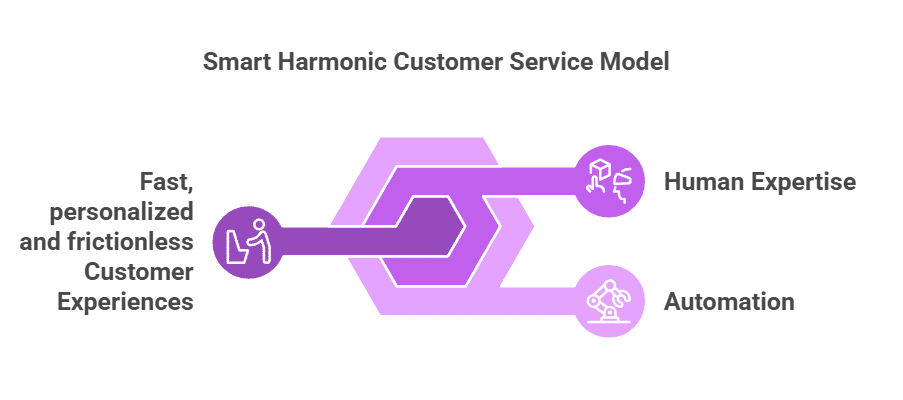
The future isn’t just automation or just humans. It’s smart harmony between both. AI handles routine questions instantly. Humans tackle complexity with empathy and expertise. Together, they deliver experiences that build loyalty.

In this new experience-first setup, customer service becomes a dynamic blend of automation and human expertise. Personalization, empathy, expertise and speed come together to create exceptional customer experiences. Common issues -70% of the current workload- are resolved upfront or instantly. When complexity arises, human experts empowered by real-time insights are ready to step in, offering tailored solutions with warmth and expertise.

Every touchpoint feels connected, intuitive and designed around you, creating a smooth, responsive journey that evolves with the customer’s experience and expectations. Ensuring customers get the speed, personalization, expertise and empathy they need… when they need it.
Discover our open, proven way of working

Transforming customer operations takes far more than new tools. It takes shared understanding, nuance, balance. That’s why our approach is transparent from the start, built on a proven method that connects structure with creativity.

We make the process visible and collaborative, so your team stays engaged and empowered to be part of the real change. Together we move through four connected phases: Define, Discover, Design, and Deploy & Deliver. Each one designed to turn insight into meaningful improvement.

By this approach your customer service becomes a dynamic blend of automation and human expertise. This transformation to a smart harmonic operations model positions your organization in the major league of customer service, where personalization, empathy expertise and speed come together to create exceptional customer experiences.

The define phase outlines the future vision for customer service, where automation enhances efficiency for routine tasks, and empowered employees address complex, high-value issues. Establish clear objectives to ensure the organization supports both digital and human interactions effectively.

  • Understand the problem to solve. Analyze the situation and its complications. Why is our current offering insufficient for the future? Identify customer expectations and your shortcomings. Assess the operational and financial consequences of the current setup. Engage with other customer service organizations and examine best practices to learn from their experiences..
  • Set up the smart harmonic customer service model by determining the key components of the intended new organization:
    • Utilize the MAYA-principle (Most Advanced Yet Acceptable) to strive for the most sophisticated organization at this stage.
    • Hybrid Teams: Form teams that specialize in digital support (AI, chatbots, self-service systems) and human support (empathy-driven, complex problem solving).
    • Introduce Customer Missions to bridge the various demarcations within the organization.
    • Introduce a multi-disciplinary approach to view processes from a customer perspective instead of an organizational point of view. Consider bringing together various functions such as customer service, order fulfillment, back office operations, data analysis, customer relationship management (CRM) and more.
    • Customer-Centric Roles: Introduce new roles like Customer Experience Lead (who oversee both automation and human support for a certain group of customers or a customer mission) and Expert Leads who are responsible for bringing the agents at a higher level.
  • Establish a clear organizational hierarchy that supports cross-functional collaboration between digital and human-focused teams and between marketing, customer service and IT.

Goal: Build a customer service organization that adapts to future needs, integrates technology, and empowers employees to resolve complex issues efficiently. Customer-Centric Focus: Ensure the structure allows for seamless collaboration between technology and human support, and enables quick decision-making around customer needs.

The Discover phase involves gathering insights from internal operations, customer perspectives and inspiration from both within and outside the industry. It also includes mapping teams to new fields of deployment.

  • Evaluate existing customer service operations and how digital tools (e.g., chatbots, AI) and human agents are currently deployed. Gather feedback from both customers and employees about their experiences with the current model. Not transactional but full experience.
    • Organizational Assessment: Assess whether current customer service teams are structured to handle a hybrid model of digital and human interactions.
    • Skills Assessment: Identify skill gaps in the current workforce for new roles (e.g., employees who can handle both digital tools and complex human interactions).
    • Technology & Process Evaluation: Review existing technologies and processes to identify areas that require investment or improvements to enable automation.
  • Gather insights and inspiration. Visit best in world service practices. Let people bring in their personal experiences.
  • Develop the ideal Future Customer Experience by creating Mission Canvasses that outline customer missions, the resources needed, and the teams required to accomplish those missions. Identify gaps, and align teams with the new Mission Canvasses.
  • Goal: Understand in detail where your current customer service model is falling short and how it can evolve to handle both automated and human-driven support effectively. Customer-Centric Focus: Ensure that feedback drives improvements in both technology and employee roles, making the model more responsive to customer needs.

The Design phase involves using the insights gained during the Discover phase to create a detailed and compelling new customer service organization including the desired transformation.

  • Customer Service Model Design:
    • Automation Integration: Set up AI-driven tools (chatbots, CRM systems, RPA) for handling routine queries like FAQs, order tracking and basic troubleshooting.
    • Empowered Human Teams: Structure cross-functional teams for complex cases, including customer support agents, product specialists, and experience managers, who will provide personalized solutions.
    • Design new Leadership: Create roles such as Mission leads, Expert leads and Cluster leads who oversee both digital and human teams, ensuring that all customer interactions are aligned with the organization’s goals. Rearrange roles and responsibilities in the leadership team. Set up new government structure including KPI’s and compliance. Set up cultural aspects of new roles and training for leadership.
    • Continuous Training: Establish continuous training for employees to equip them with skills in deeper and cross functional (T-shaped) expertise empathy, problem-solving, AI tools and decision-making.
  • Support setup: design new roles to facilitate the new way of working. Integrate these roles into the teams when this enhances customer speed. Additionally, design the coordination of support across the teams..
  • Technology Setup: Implement the necessary systems and tooling (AI, CRM, knowledge bases) and provide employees with the tools to access customer data in real-time for context.
  • HR track: outline the implications for roles/functions, responsibilities, reward systems, teams, management and support teams.
  • Develop the roadmap for transformation: Plan the transformation in a timely manner and coordinate with other roadmaps (IT, HR, etc.).Ensure that there is a solid routine for appointing team members, training them and adapting to their new roles. Back-fill where necessary to avoid overburdening the new teams with excessive workload and to prevent customers from suffering due to service implementation issues.
  • Facilitate decision-making, including consulting with work councils or unions when necessary.

Goal: Create a seamless, hybrid model that integrates both automation for efficiency and empowered humans for complex, personalized service and supports a flexible organizational structure. Customer-Centric Focus: The design ensures that customers experience personalized, efficient support regardless of whether the solution is provided by a bot or a human, with smooth transitions between both.

The Deploy & deliver phase is about implementing and launching the new customer service model, ensuring all teams, roles and technologies are in place to deliver the service to customers.

  • Organizational Setup: Structure teams around hybrid workflows and customer missions, with digital support managing simple inquiries and human agents addressing more complex cases. Implement in phases, aligning the activation and training of new teams with the required operational capacity. Initiate the new support roles accordingly.
  • Facilitate the adoption of the new way of working for teams and management/leads. Integrate coaching within the teams and provide intensive coaching for leads in their new roles.
  • Implement a solid procedure for quarterly business reviews (QBR) on desired improvements, followed by a cascade of these improvements into weekly and daily routines.
  • Technology Deployment: Roll out AI-driven automation tools, while also providing employees with access to real-time data and customer insights. Ensure they have the authority to solve problems without unnecessary delays.
  • Continuous Monitoring: Implement systems for real-time monitoring and analytics, allowing leadership and teams to track performance, identify improvement areas and adjust both automation and human workflows as necessary.
  • Customer Feedback Loops: Set up processes to continuously collect and analyze feedback from customers to refine the customer service model, ensuring that it’s always evolving based on customer expectations.

Goal: Successfully implement the new hybrid customer service model, empowering employees to offer tailored, empathetic support while ensuring automation handles simpler tasks efficiently. Customer-Centric Focus: By delivering an effective, hybrid model, you ensure that customers receive consistent, personalized and quick service, whether interacting online, with a bot or a live agent.